
Making Sense of AI: Ethics, Literacy and Governance for NGOs and mission-led organisations

AI is already entering NGO work through writing tools, translation, data analysis, communications, fundraising, research, HR systems and donor platforms. For mission-led organisations, the challenge is not simply to ‘adopt AI’, but to decide where it is useful, where it is risky, and how it can be used in ways that protect trust, dignity, accountability and organisational purpose. This practical workshop helps NGO teams build AI literacy, examine realistic use cases, and begin developing a proportionate approach to responsible AI governance. Many NGOs are now in an awkward middle ground: staff are experimenting with AI, leaders are conscious of risks, but few organisations have had the time or space to develop a shared position.
‘AI literacy’ means more than ‘prompting’ or productivity with AI. Practical AI literacy is also becoming a governance expectation. Article 4 of the EU AI Act makes AI literacy a specific requirement for organisations that provide or deploy AI systems within its scope. For NGOs working across jurisdictions, with international partners, donors or affected communities, it also points to a wider expectation: organisations should not treat AI as a purely technical or productivity issue, but as something requiring informed judgement, accountability and care.
AI Ethics, Literacy and Governance for NGOs Workshop
This workshop – half day or full day workshop (face to face, online or hybrid) includes a combination of key learning materials, evidence-based research on AI in organisational contexts, and practical activities. We will work with realistic AI use cases throughout the workshop. The agenda can be adjusted according to current staff understanding and confidence in AI; and also sector context.
About the trainers
This training has been developed by two trainers who combine expertise in law, human rights, international development, research, coaching and AI ethics. It is designed for mission-led organisations that want more than just generic AI enthusiasm.
 Deborah Manning (The Good Practice Company). An experienced barrister and Senior Lecturer at AUT Law School. She has practiced in public law and human rights law for over 25 years, with extensive experience practicing primarily in refugee and public law. As a dedicated practitioner advocating for vulnerable clients, she has worked both in New Zealand and internationally including engaging with UN human rights mechanisms in Geneva and with civil society. Recently completed training in AI ethics, regulation and compliance programme at Said Business School.
 Andy Nobes (Independent trainer and coach, previously INASP). An accredited coach and trainer with twelve-years experience working in international development at the intersection of research, training and publishing, and supporting researchers and academics in the Global South. Now researching the use of Artificial Intelligence in coaching and education, with two recent peer reviewed papers exploring the use of AI in coaching, and what skills remain distinctively human. Recently completed training in AI ethics, regulation and compliance programme at Said Business School
By the end of the training (through six modules), participants will be able to:
- Understand what current AI systems can and cannot do, without needing technical expertise.
- Discuss AI use across teams using a shared language for benefits, risks, values and accountability.
- Identify realistic AI use cases in their own organisational context.
- Recognise common AI failures, including bias, hallucination, opacity, privacy risks, poor evidence use, and over-reliance.
- Connect AI decisions to organisational mission, values, stakeholder trust and ethical boundaries.
- Understand the wider governance landscape, including the EU AI Act and international principles for trustworthy AI.
- Begin drafting a simple, proportionate AI governance approach for their organisation.
(Based on a full-day, 6 module workshop.)
Workshop formats and costs (for UK and Europe)
| 90-minute introductory session (virtual) – for leadership teams or staff groups who need a first orientation | Virtual: £400 plus VAT |
| Half-day workshop – for teams ready to explore use cases, risks and values. 3-4 modules adapted as appropriate | Virtual: £600 plus VAT
Face-to-face: £750 plus VAT |
| Full-day workshop (face-to-face) – for organisations wanting deeper training, stakeholder discussion and a draft AI governance framework. 6 modules | Virtual: £900 plus VAT
Face-to-face: £1100 plus VAT |
NB: Face-to-face workshop fee to also include travel expenses
Facilitators: UK and Europe face-to-face workshops will generally be facilitated by Andy. Some online or hybrid workshops can be co-facilitated by Deborah, but additional costs may apply.
Optional hybrid option: A combination of face-to-face sessions and online can be arranged over two or more days.
Next steps: AI Auditing with Oxethica
For organisations that want to move from training to diagnosis, we can also carry out a full comprehensive AI audit with the cutting edge Oxethica platform. As Oxford University-accredited AI ethicists, we have access to this auditing platform and tools, which were developed by Oxford Internet Institute and the Saïd Business School. Auditing involves interviews with key members of staff responsible for AI integration, followed with a full written report and recommendations.
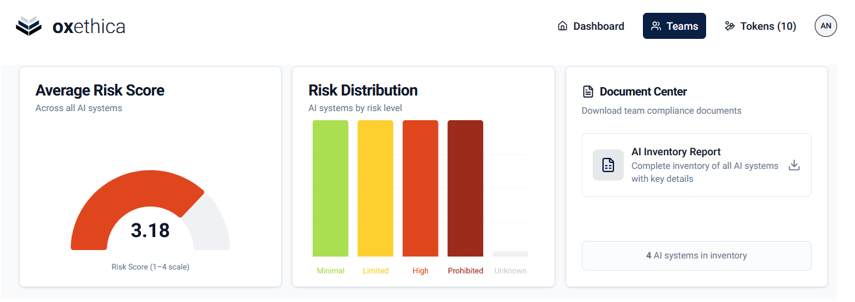
Example dashboard showing AI systems by risk level and inventory status.
A full audit using Oxethica starts from £500, and depends on the scope and scale of your organizational work with AI.
 Start with a quick AI reflection
If your organisation is still working out what it needs from AI training or policy support, you can begin with the Responsible AI Radar.
This free tool helps you map some of the early questions: how AI is being used, where uncertainty or risk may be emerging, and what would be helpful to discuss as a team. It can be used before a workshop, leadership conversation or policy-development process.
Explore the Responsible AI Radar