
 (this was originally a LinkedIn post on the 16th January)
It was great to attend the International Coaching & Mentoring Conference again at Oxford Brookes University to catch up with the latest research.
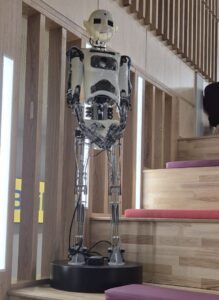
Very appropriate to be greeted at the entrance by this guy. Okay, so AI wasn’t the main topic of the conference, but many of the presentations I saw touched very clearly on the complexity of the human experience in how to hold a meaningful reflection space for another person, and made me wonder again whether AI has the nuance and range to replicate this in practice (and whether we want it to).
First up was Kate Cuthbertson MA‘s research on the challenges of new coaches having to coach social workers with an increasing amount of responsibility without agency, and the value conflict/moral injury this can cause. She described how new coaches’ confidence emerged through tolerating not-knowing, and letting go of expertise to hold a space for social workers’ ethical sensemaking within a challenging systemic context.
Good to hear Pat O’Leary putting the dhukka (suffering) back into mindfulness! He focused on mindfulness as a coaching stance that coaches can draw upon in difficult conversations, allowing them to remain grounded, emotionally regulated and present.
Also looking at coaching difficulties, Letishea McLean focused on failure in coaching, the disruption to practice, the embodied pain of failure in the short term and more chronically in the long term; and the importance of reflecting on this lived experience, so coaches can integrate this learning into their practice.
Julie Collings‘ research on the emerging field of climate coaching looked at how ‘climate conscious’ coaches navigate values, purpose and interconnected systems of self, client, society and planet; whilst maintaining integrity, transparency, and respecting the autonomy of the client.
Professor Rebecca Jones looked at how experienced researchers make decisions in the moment with their unique intuition, skillsets and experiences, but also balancing their own bias and subjectivity.
Two presentations directly addressed AI chatbot coaching, which is increasingly challenging human competency coaching standards:
Associate Professor Sean O’Connor importantly noted some of the broader issues in human/AI interaction which may cross over to AI coaching – diminished attention and cognition, lower quality learning, shifts in relatedness etc.; and also how AI tends to be sycophantic, when what we want in coaching is actually conversations that challenge people.
Zunaira Awan’s research compared how coaches’ practice is grounded in the ‘evolving self’ (characterised by lived experience and reflexive capacity) with AI coaching’s ‘absent self’ – which may improve statistically, but not reflect and truly ‘grow’. The most urgent question for coaching is not ‘can AI coach?’, but ‘what does it mean for our profession if it *appears* to?
It was also great to meet Juyeun Kim, who is currently doing some really innovative research on coaching chatbots in the Korean context, which I’m looking forward to hearing more about (especially as it’s a mixed methods RCT) – it’s really important that we have more research on AI coaching from outside Europe and the US, where there are different perspectives on both AI and what coaching means.
Thanks Julia Papworth, Dr Ioanna Iordanou and the rest of the Brookes team for organising a great learning event